Showing posts with label fuck you j. p. ricciardi. Show all posts

Thursday, October 6, 2011

Cardinals 5, Phillies 3: Go Squirrel!

go squirrel go squirrel go squirrel
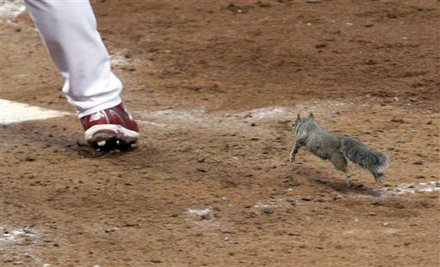
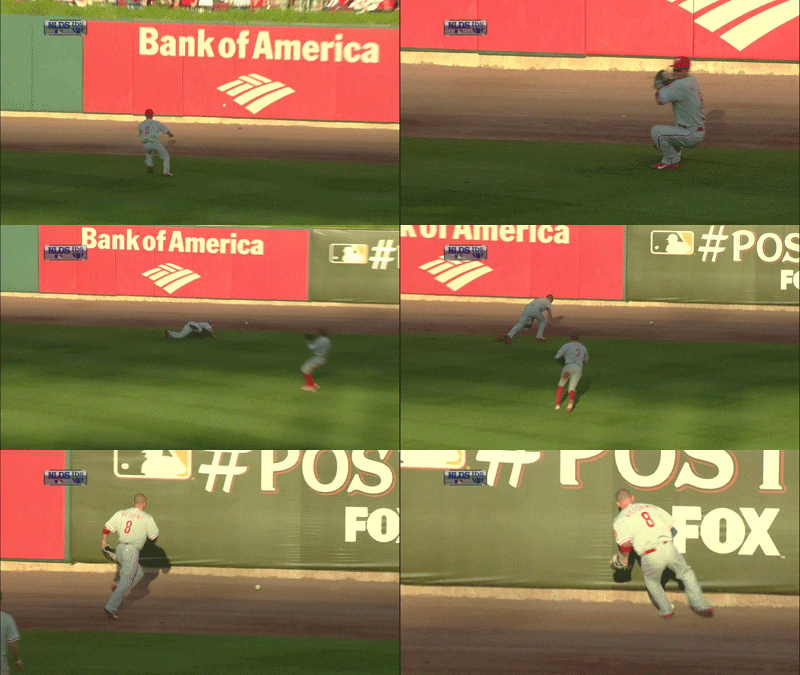
For the second day in a row, a squirrel -- the same squirrel? --- stole the show in St. Louis, and I am all for it, let me tell you. Tuesday night, s/he bombed around the infield and booked it down the left field line; last night, the marvelous creature you see in the above photograph made an appearance whilst Skip Schumaker took his cuts. Other cool things that happened: Shane Victoriano fell all over himself trying to get the ball back in from centre, and ended up throwing it behind him, which is not something you see every day; Albert Pujols pulled off the bag at first on a throw from short because he saw the runner at second breaking for third, gunned it, and got the out, which was amazing, frankly; Scrabble struck Ryan Howard out swinging in a key at bat late; and David Freese went berserk with a three-run home run and an RBI double. From that catalogue of notable occurrences, you might conclude that I have hopes for the Cardinals, but that is not in fact the case: it is entirely my hope and desire that Roy Halladay best Chris Carpenter Friday night in a winner-take-all showdown of former Blue Jays starting pitchers whom I will never forgive J. P. Ricciardi for losing. Play ball!


KS


UPDATE UPDATE UPDATE 


Here's Victorino:


also there is SQUIRREL GIF:


HERE HERE HERE is a link to some squirrel video, and below you will find an outstanding single frame from that video, which I have captured on my own using advanced computer technologies.


Friday, September 16, 2011

Keith Law vs. Michael Lewis: Everybody Is Jerks

Mean mugging.
It is of course entirely possible that in his private life, ESPN.com's Keith Law is a kindhearted and generous spirit. But he is, in both print and the delicate art of podcasting, totally a jerk, right? Would we all agree on that point? I genuinely enjoy his work, so this is not intended as a dismissal or broad condemnation of all things KLaw, but even an admirer of much of what he does -- and I am indeed an admirer -- has to concede that Law's entire public persona is about belittling people whom he has decided are dumb, right? And he has decided that an awful lot of people are dumb. That is, I think, a pretty uncontroversial characterization of what it is Keith Law does, in addition to knowing everything about every prospect ever. 


This week, Law attended a preview screening of Moneyball, the Brad Pitted adaptation of the Micheal Lewis book we have all read because we enjoy baseball and are on the internet. And, as he outlines on his blog, he did not care for it: "Moneyball, the movie, is an absolute mess of a film, the type of muddled end product you’d expect from a project that took several years and went through multiple writers and directors. Even good performances by a cast of big names and some clever makeup work couldn’t save this movie, and if I hadn’t been planning to review it, I would have walked out." There are those who have pointed out that this runs counter to most professional reviews of the movie so far, but to that one can only say whatever, and, writing as someone who has himself both reviewed professionally and been professionally reviewed, let me add a second "whatever," because, seriously, whatever. Who could possibly care that? That is a pretty silly thing to point out, I think. Anyway, Christopher Rosen of the site Moviefone, which I knew nothing about until yesterday, got in touch with Michael Lewis, and asked him what he thought of Keith Law's take. The result is an ethering:


"Billy [Beane] called me and said Keith Law had sent him his review. I looked at it and I thought, What's he talking about? It's very weird that he's on this. He's intellectually dishonest, and I don't know to what purpose. I don't understand why he goes from being -- when I interviewed Keith Law, and I did, at length -- he was so nasty about scouts and scouting culture and the stupidity of baseball insiders. He was the reductio ad absurdum of the person who was the smarty pants who had been brought into the game and was smarter than everybody else. He alienated people. And now he's casting himself as someone who sees the value of the old school. I can't see where this is all heading and why. But I learned from experience that the best thing to do is ignore it, because it goes away." 


First off, were Michael Lewis ever to denounce me as a smarty pants, I would probably never stop crying. That is absolutely brutal. I might very well be a buffoon in any number of ways, and were Michael Lewis to point that out to me, it would be rough, but I could probably handle it, I think. I could maybe even survive being characterized as intellectually dishonest, maybe, although that's actually pretty rough, but imagine, imagine trying to get through a single day of the rest of your now completely unlivable life after Michael Lewis called you a smarty pants, and, moreover, was right. Keith Law is totally a smarty pants. That is completely true.


Understandably, all of this cut Keith Law to the bone, and he took to the airwaves/internet tubes to respond in a way that tells you way more about the weird Blue Jays front office under J. P. Ricciardi than you probably ever thought you'd know. You can listen to the audio here (about nineteen minutes in, and worth listening to for Law's idiosyncratic pronunciation of the word "caricature" if nothing else), or you can read a transcript of this pretty remarkable and revealing stuff below -- endless, endless internet propers to the mighty Drunk Jays Fans for actually transcribing this, as transcription is agony:


When Michael interviewed me for Moneyball-- there was one long interview in particular in my office in Toronto; I can still picture where he sat, where I sat-- this was 2002. I was 28 or 29, less than a year into my job with the Blue Jays, which was my first job in baseball at all.

Before that I had been a freelance writer, a little for ESPN and a lot for Baseball Prospectus. I was very much a stats guy-- only a stats guy-- I had no scouting experience.

I was hired by JP Ricciardi-- who was the the General Manager, who came out of Oakland, worked for Billy Beane-- who had been a scout, but did not respect scouts or scouting. In fact, one of Ricciardi's favourite things to do, especially the first six months or so I was there, was call me into his office-- or sometimes just call me on the phone, if I was still in Massachusetts-- he'd pull out this binder-- this gives you a sense of how long ago this was-- this binder that had all of our printed scouting reports that amateur and pro scouts had turned in on all of these players that they'd seen, and he would pick a player that he liked. "Hey, let's go see what our genius scout said about Eric Hinske!" And I could still remember-- I know who the scout was, the scout's now a cross-checker with a National League club, and a friend of mine-- "You know what!? This idiot, he thinks Eric Hinske's an org. player!"-- which means a guy with basically with no Major League value, a guy who's good for a Double-A or Triple-A roster but that's about it-- which was a little light, but what is Eric Hinske? He's an extra player in the big leagues. I don't think that's a disastrous report. But this was how Ricciardi viewed scouts, particularly the Blue Jays scouts he inherited. And he ended up firing, or not renewing, more than half of the scouting staff, as I can remember-- many of whom have gone on to senior positions in other scouting departments.

So... I'm not trying to make an excuse here, but just to give you an idea of my mindset at the time. My whole baseball universe was my own work as an analyst, and the guy who brought me into baseball, who was my boss and somebody I admired at the time [oh shit "at the time" -- KS] and was trying to learn from, telling me, "Most scouts are useless," even though he had been a scout himself. And at the time that I sat down with Lewis, I was giving him the party line-- something I believed in, absolutely. That was nine years ago, give or take a few months, and I've only spoken to Michael once or twice since then-- I did talk to him a year or two later; he was planning to do a follow-up book that I think fizzled because the players drafted in the so-called "Moneyball Draft" didn't work out as well as hoped.

About two years, two-and-a-half years after that-- so 2004, 2005-- it became pretty clear to me that we were failing. And this was one of the major reasons I left Toronto. There were a couple-- that's a topic for another day-- but, it wasn't working. The stat-heavy approach was... we were basically two steps behind. What we were trying to do was what Oakland had been doing around 2000 or so, and the Red Sox and the Cardinals and the Padres and one or two other clubs-- Cleveland-- they were pretty clearly adopting some of these same methods. And we were left in the situation-- kind of a similar situation to where we were before we even got there, which was that we weren't innovating fast enough, and the market had become too competitive for the limited type of player we were going for.

It really became apparent to me in the draft room. I remember Tony LaCava-- who is still there, who is Alex Anthopoulos's right-hand man in Toronto-- independently had realized the same thing, which was we were killing ourselves, especially in the draft, because we would only take college players with "acceptable" stats. And that's such a narrow pool, especially when five or six teams are all going for the same type of player. You get to the third or fourth round and you're done. There's nobody on the board you think could even be an average regular in the big leagues. 

He and I both spent a lot of time between the '04 and '05 drafts, and again between '05 and '06, trying to convince Ricciardi, "We've got to change this; we've got to incorporate more scouting into our process; we have to be willing to look at high school players; we have to be willing to take some of these higher risk tool players who maybe don't have the perfectly acceptable stat line but give us some upside, some chance to look for hidden value that other clubs aren't identifying." And one of the reasons I left in 2006 was the recognition that this approach-- this so-called "new school" or "Moneyball" approach-- was not going to work. Was never going to work. And they ended up scrapping it after I left.

But while I was there I worked with many scouts-- like I said, some of whom have gone on to success with other clubs, many of whom are friends of mine now, and I have to say, many of whom tried to open my mind in 2002, 2003, when I was not open-minded, when I was 28, 29, and walked in the door and was told, "You're here, you're gonna replace ten scouts with the work you do." And I believed it, which was a terrible mistake on my part.

I recognize that Chris Buckley, now the scouting director with the Reds, and Tim Wilken, who's the scouting director with the Cubs-- these guys were trying to help me. Trying to open my mind. Mike Cadahia-- who is a cross-checker who was just let go from Seattle, but who is, I think, a very good scout and a very good person, and I hope to see him land somewhere soon-- he was trying. These guys were trying to help me realize that there are more ways to do this. And the more inputs you have, the more information you have, the better the decisions you're going to make.


Part of what I came to ESPN with in 2006 was this vision for a different kind of writing that incorporated everything. And so, when Michael Lewis claims that I was nasty about scouts and scouting culture, there's a kernel of truth inside the caricature which he paints-- which is kind of what he did to several people in the book-- Paul DePodesta, I think; there's a kernel of truth to the caricature of DePodesta in the book Moneyball. But to say that I'm "casting" myself "as someone who sees the value of the old school?" No, I see the value of the old school, and have for five or six years now. And I have tried-- I won't sit here and tell you I'm successful-- but I've really tried to incorporate both of those things into my writing.

And, I have to say, a lot of the credit for that goes to LaCava, Buckley, Wilken, Cadahia and Billy Moore, and Jeff Taylor, and Mike Mangan-- these are all people that I worked with in Toronto, and I'm apologizing for forgetting ten other people I should be crediting here. But they worked with me, they opened my mind, they showed me the beginnings of how to evaluate, but at a time when I wasn't receptive to it. They tried to show me the importance of this old school, of scouting players from a traditional perspective. It just all caught up to me-- two, three years after the fact-- that they
 weretrying to help me, and that I had kind of missed out-- maybe set myself back in the process. And leaving for ESPN kind of gave me the opportunity to start over and make this major change to my philosophy of baseball, which is what I think you've seen over the last couple of years in my writing.


This is all, in my view, bananas. As I have said before, the loathsome J. P. Ricciardi era is completely fascinating to me, since it's the time when I was at the ballpark pretty much every day, following the team as closely as anybody can, really: I was a graduate student at the time and thus completely unencumbered by the duties and responsibilities that come along with being a real person. So, any insight into how any aspect of that disaster (theirs, not mine) took shape, I totally welcome. I think it's also worth noting that it comes across like Law is kind of blaming Michael Lewis for not keeping up with the personal and professional development of Keith Law, as though Lewis should have signed up for an ESPN Insider account and realized the extent to which Keith has grown and changed over the years, when obviously Michael Lewis has no reason to care about that in the least, as he has been plenty busy being Micheal Lewis. That's kind of funny. But more than anything else, I am sympathetic with Law in all of this. Who among us was not a know-nothing-know-it-all in their twenties? Who among us does not regret this -- at least a little; maybe a lot -- now that we're older and least a little less convinced of our own genius, or even competence? We are all of us Keith Law, is what I am trying to say here, at least those of us who were smug jerks in our twenties but have more recently begun to realize that, beneath our smarty pants, we are all of us butts.


KS  

Wednesday, August 3, 2011

Blue Jays 3, Rays 1: Oh Hell Yes

Note the blue stitching on the glove that reads "Romero" and which is entirely correct
Verlander vs. Weaver is a hard act to follow, but Ricky Romero against David Price had the potential to be such a battle of such lefties, of such lefties, that I must admit that I went into this one especially excited. Also exciting: the Blue Jays entered the series only a game-and-a-half behind the Rays for third in the AL East, and while both teams are so far back of the Yankees and Red Sox that that shouldn't matter at all, and in fact does not matter at all, it is still totally matterful to me, in that: the greatest indignity of the J. P. Ricciaridi era was when, after years of being told the Blue Jays just couldn't compete with the Red Sox and Yankees because Toronto was a small market (despite being the seventh largest city in North America, with broad support across a nation of more than thirty million people, arguably the richest owners in all of baseball, and a league-leading payroll less than a decade before Ricciardi took the reigns), Tampa Bay came out of nowhere and totally blew the doors off of everybody in the AL East, and that sucked. A lot. Good for the Rays, by all means: they are crafty and clever and neat, and despite how awful Jonah Keri's book about them was, they are a pretty interesting organization, one that should probably move because they play in a pit and nobody likes them, but whatever(s). My problem is not with the Rays; my problem is with being worse than the Rays, because that is inexcusable and unacceptable in every way. The Toronto Blue Jays should be better than the Tampa Bay Rays every single year. And maybe this year they are? They've still got a ton of games head-to-head, and that's probably what will decide where these two also-ran teams fall out relative to one another, but right now, anyway, we're closing in! 


Anyway, last night's game was a total honey. Ricky Romero got into and out of trouble early, loading the bases with nobody out in the second on a hit batter and two walks, but struck out a pair and got Sean Rodriguez to ground out to Bautista. There were no hits that inning, and in fact only one off of Romero all night, a Desmond Jennings solo shot in the sixth. That Jon Rauch came on and allowed more hits in his lone inning of work than Romero allowed in the previous eight should surprise literally no one, and whoever wrote the "Romero and Rauch Combine for Three-Hitter" headline I saw somewhere should give his head a shake. Also if you enjoy home runs by Jose Bautista and Yunel Escobar as much as I do, then you, like me, were in luck last night.


So yeah: Ricky Romero's ERA is down to 2.98; the Blue Jays have finally beaten David Price, who came into the game 8-0 against them; and Toronto now trails Tampa Bay by a mere half-game, which is utterly meaningless unless you are still working out your personal issues with J. P. Ricciardi after all these years. Good stuff!


KS

Tuesday, May 24, 2011

Blue Jays 7, Yankees 3: Everybody Loves Intentional Walks

Bartolo Colon: way too fat for this nonsense.
Through five innings, the only runs on the board in this well-pitched affair came off a Robinson Cano sac fly that plated Granderson in the fourth and a pretty spectacular Jose Bautista lined shot to left centre in the first, the nineteenth home run of his hater-confounding 2011 campaign. That Bartolo Colon was getting it done was not shocking; that the spot-starting Carlos Villanueva was doing likewise caught me a little off-guard, which is really a shame-on-me scenario because he's been awesome so far out of the pen (1.48 ERA), and it's not like he's never started before, so who am I to doubt Carlos Villanueva?  


Then, in the sixth, things got pretty wacky: Corey Patterson -- who doubles often, bless him -- doubled. In a tie game, with nobody out and a runner on second in the sixth, they walked Bautista, which is what is going to happen now, I guess, and so be it.  Adam Lind is still rehabbing his bad back, meaning we are utterly and completely without a cleanup hitter, and so it fell to Yunel Escobar to drop the sacrifice bunt, the first time a Blue Jay batting fourth has dropped a sac bunt since . . . Dave Winfield in 1992! Why would anyone have ever asked him to do that? Cito, man. A character. Anyway, that puts runners on second and third with one away, so Girardi decided to walk Juan Rivera to set up a potential inning-ending double play, and I get that, but man he must have been kicking himself when Aaron Hill singled in a run, Eric Thames worked a bases-loaded walk, and J. P. Arencibia ripped a three-run double. Kicking himself.


The home half of the sixth was starting to look pretty nutty too when Escobar botched a double play ball, allowing a run to score and making things at least a little ticklish for a minute there, but as bad as things might be going for you as a pitcher facing the Yankees, you know that sooner or later Jorge Posada is coming up so everything is going to be cool. Twice last night, Posada grounded out to end innings with two runners on. As an aficionado of this great sport, you have probably already heard about how Posada got all mad about batting ninth the other day, and then asked to be taken out of the lineup completely for a game, and then felt kind of silly about the whole thing and apologized? If not, that totally happened, and if you were wondering just how bad he's been, last night Jerry Howard said that Posada was 0-26 on the season batting from the right side. I'm not going to look that up, but if that is what passes for switch hitting these days then shit I'm a switch hitter, too.


Just how bad has Posada been? And please note that I have no problem with Jorge Posada, who has had a totally admirable career: totally passable defensive switch-hitting catchers with power from both sides of the plate are basically the bee's knees. But this season, he is the 25th worst player in the American League by WAR at -0.4 (he's 253rd if you are counting in the other direction), and I really like WAR as a stat for measuring awfulness because of its cumulative nature. It gives you a better picture of awfulness than rate stats: to put together a seriously negative WAR you've got to be out there actively sucking, not just be theoretically bad and sitting on the bench, you know? 


Also while plumbing the stygian depths of the Baseball Reference WAR leader board, I can't but notice that Travis Snider -- who hasn't even been in the league for a pretty good little stretch now -- was every bit as bad as it seemed: he's rocking a 6th-worst/272nd-best -0.8, and E5, who I had recently speculated might be the worst major league player getting regular playing time right now, is in fact only the 4th worst! Carl Crawford is still somehow faring even more poorly, and I had no idea Joe DiMagglio was having the kind of year he's having. Vernon, we knew he was this bad. And there's your top four. Bottom four. You know what I'm saying here. 


Finally, if you still totally hate J. P. Ricciardi (and who doesn't?), it's perhaps worth noting  that two of the worst nine players in the American League right now are being paid a combined $35 million this season on deals originally signed by the Blue Jays but mercifully foisted onto others since. When J. P. Ricciardi was all you think you know baseball in this city but you don't, we were wrong to doubt him.


I don't want to end on so sour a note, so in closing I offer this image of Jose Bautista's swing, which at this point should really be filling all of us with joy, regardless of rooting interest, because it is so awesome. And he is so awesome. And baseball? Unfailingly awesome, even at its ruinous worst.


Yep.
KS

Friday, April 15, 2011

Had I mentioned previously that Carlos Delgado is my favourite baseball player?


Carlos Delgado, my favourite baseball player, retired yesterday. You might find upon reflection that even though you are an obsessive and devoted baseball fan, you don't really have a favourite baseball player, exactly, and really haven't since you were twelve, and that would be reasonable and fine. But on a cold winter day not long ago -- the Saturday after the Vernon Wells trade, I believe it was, a time when I was (baseball) feeling particularly reflective -- I was asked who my favourite baseball player was, and I took the question pretty seriously. I have no doubt that we can all name, like, a dozen or so players we're really very fond of, and if pressed we could all probably cut that number in half and say, "OK, here are the best guys, seriously; I love these guys." But if you had to narrow it all the way down, and say definitively who your favourite baseball player is, that's tough, unless you've already thought it through and correctly determined that Carlos Delgado is the best, and thus totally your favourite baseball player.    


That this period of reflection came in the wake of the Vernon Wells trade was no accident: Vernon, as I no doubt mentioned in any number of posts at the time, was truly my last remaining dude, the last of the Blue Jays from the period when I was at the ballpark almost everyday for a few years (Jason Frasor doesn't count). Those Blue Jays teams weren't good, but I had never before been and will never again be that close to baseball on a day-to-day, who's-pitching-tomorrow, let's-go-down-early-and-watch-BP way, and so it's pretty likely that I will never feel a closer connection to a baseball team than I did to those generally pretty bad teams. I mean, I can tell you absolutely everything you need to know about the 1992 and 1993 Toronto Blue Jays -- of course I can -- but I can also tell you absolutely everything you need to know about the 2002, 2003, and 2004 Toronto Blue Jays, which is way different, I think, in that there is absolutely nothing anybody ever needs to know about any of those teams. But they are totally my teams. The 2003 Toronto Blue Jays are, oddly enough, my favourite baseball team. It is much less odd, I think, that Carlos Delgado is my favourite baseball player.


It's worth noting that since Delgado announced his retirement on Wednesday, almost nobody has been a jerk about it -- and this, of course, is the internet. Somebody tried for a minute to be a dick about Carlos in a thread on Baseball Primer, but he was quickly shouted down (I'd link, but that place is just kind of smug most of the time. I don't know why I still go). Delgado is almost universally admired, and rightly so, as he is the best. Stephen Brunt has a nice piece in the Globe and Mail talking about how Carlos came up (as a catcher, you will recall) just at the tail end of the Blue Jays long run of being awesome, and while Carlos himself went on to be awesome, the Blue Jays sort of did not. David Schoenfield has "Ten Random Thoughts on Carlos Delgado" at espn.com, and that's worth your time, too. Even the straight-up AP story is really good. 


What I have been most struck by, though, was Keith Law's response to a listener email on the Baseball Today podcast yesterday. Law, who worked in the Blue Jays front office from 2002 through 2006, and who as you know is generally unencumbered by any human emotion other than disdain, responded thusly when asked whether or not Carlos Delgado should be in the Hall of Fame:
Because I know Carlos, and saw that 2003 season when he nearly won the MVP, he hit the four home runs -- I actually saw a four-home run game, because of Carlos Delgado -- I would love to say yes. But I do think he falls just short, and I don't think he's going to get a lot of support from voters, unfortunately. He was -- is -- a great guy, and he was tremendously fun to watch in addition to being really productive. 
Law then goes on to talk about the enormously high offensive standards that exist for players on that end of the defensive spectrum, and says that Delgado has to be considered just behind Fred McGriff, who the voters have already decided is not a Hall of Famer, and so there's probably not much of a discussion to be had here. But again, what I think is significant here is not the analysis (which is spot-on), but the fact that Keith Law, whose response you could very well have expected to have been "lol no," instead goes with an apologetic "I would love to say yes." The only explanation that would account for that oddly out-of-place note of humanity in Law's voice is that Carlos is awesome.  


I could go on -- and will, a little -- but such is the extent of my baseball feelings on the subject of Carlos Delgado that they legitimately threaten to sprawl across an endless series of incoherent posts that mostly involve rendering his name in all-caps and with way too many o's, but I will try to reign that impulse in, and focus on a few essentials.


THE FOLLOWING THINGS ARE TRUE ABOUT CARLOS DELGADO AND I DON'T CARE IF SCHOENFIELD BASICALLY STRUCTURED HIS ARTICLE LIKE THIS I AM GOING TO DO IT TOO BECAUSE THERE IS NO WAY CARLOS MEANS AS MUCH TO DAVE SCHOENFIELD AS HE DOES TO ME:


(i) Law mentions that four-homer game. Let's start there.  


It was so awesome.


It was actually also a pretty good game, with the lead see-sawing back and forth until the Blue Jays tied it and went ahead for good in the eighth. I had uncharacteristically OK seats that game, and so instead of the upper deck I was sitting in the 100s in left-centre, which gave me a really good sense of the truly ridiculous speed with which home runs number one and four left the park and struck the restaurant in centre field. The first of the four was the 300th of Delgado's career, a three-run shot with which he broke his own team RBI record (he'd finish the year with 145). The second was a scraper; the third had a little more on it than that, but holy cow did he ever get a hold of that fourth one. Just a blast. Delgado hit the ball as hard as anyone I've ever seen. 


I think my favourite thing about the four-homer game is actually something that happened the next night: a standing ovation for his first AB, a great buzz in the crowd as he ripped a couple of balls foul, and then another big ovation when he struck out. It was great.


(ii) In the last few days, much has rightly been made of Delgado's class and dignity, and quite rightly, because, I mean, yeah, absolutely, Carlos Delgado is a classy and dignified guy. And just, like, sensible, you know? “There comes a moment when you have to have the dignity and the sense to recognize that something is not functioning," he said at his retirement speech. Dignity and Sense: The Carlos Delgado Story. 


But one of my preferred Carlos moments came in a momentary lapse in class and dignity and sense, sort of: July 15, 2002, with the Blue Jays leading the Yankees in the seventh. Orlando Hernandez had already been dinged for six runs, and was clearly not loving that. His first pitch to Delgado in the seventh actually went behind Carlos, and Carlos -- who never makes a big show when he gets pitched inside -- started yelling at Hernandez in Spanish so loudly and so clearly and so awesomely that I could hear him from my seat in 540, so we're talking upper deck, left field, 328 feet from home plate with the roof open and 25 371 people in the building (I have a scorekeeping book!), and I can hear Carlos getting heated up from all the way up there. It was totally out of character. The managers came out of the dugout, but everybody else stayed cool, until El Duque hit him with the 3-1 pitch and got tossed. 


(iii) Unfortunately I might not get the exact details of this right, but one day one of the giveaways at the park was what I believe to have been sets of Blue Jays bookmarks that had a bunch of information about different players, not stats, but the kind of information it is assumed kids will like: you know, hobbies, what they had wanted to be when they grew up, and things like that. They might not have been bookmarks, but whatever, they definitely would have marked your place in a book if that's what you were after, and they were definitely for the kids. Anyway, all the information was pretty standard, really, pretty much what you'd expect when you ask a bunch of questions like that to a bunch of ballplayers. It was all completely unremarkable. But for whatever reason, I distinctly remember that Eric Hinske listed "X-Box" as his hobby, and Carlos listed Cien años de soledad as his favourite novel, and it kind of confirmed what should already have been totally clear to anybody who'd been paying attention: Carlos Delgado was an adult surrounded by a bunch of idiot kids.


(iv) It's actually quite a feat to have played the bulk of your career in Toronto during the height of what we have apparently all agreed to call The Steroids Era and to have somehow managed to keep your name entirely, faultlessly intact. If you have perused the Mitchell Report -- and every time it comes up, I know I urge you to do just that, and I really mean it -- you will be familiar with the extent to which the Blue Jays locker room circa 1997-1998 was basically where that guy had sex with the monkey in terms of the spread of steroid use, if you follow me. OK, no: Oakland, but Toronto was right up there. And not once ever, not even in a sly kind of way, has Carlos Delgado's name every been associated with any of that. Maybe if Carlos were a slightly more serious Hall of Fame candidate, people would Jeff Bagwell him, and assume because he was a big power hitter playing in that era, there's no way he was clean (I may have mentioned before that I find this unfair to Jeff Bagwell?). But Carlos kept his name out of all of that, either by legitimately being clean, which is honestly what I think, or else by some serious Smiley/Karla-level subterfuge, and either way, you've got to respect that. The case has been made that we should look at Carlos' numbers and almost kind of adjust for the fact that he was a clean player playing in a dirty league and approach his numbers accordingly, but that's kind of crazy. Interestingly, when later asked how he felt about losing out the 2003 AL MVP to Alex Rodriguez, who of course admitted to using performance enhancing drugs that season, Delgado's answer was basically that it sucked a little.    


(v) About that 2003 near-MVP season: Carlos was an absolute beast, putting up a .302/.426/.593 with 42 home runs, but it wasn't even his best year. In 2000, the only other year he so much as made an All-Star team (isn't that weird?), he put up a .344/.470/.664 with 41 home runs and a total of 99 extra base hits. That's just so many extra base hits, man. To return unartfully to the 2003, though, one of my preferred Carlos moments is the grand slam he hit on the last day of the season. It was just, like, go Carlos.


(vi) The silent protest against the observance of "God Bless America" is something that tends to get some people riled up, and I get that. But also, you should settle down. First of all, let me say that while I am in many ways your standard issue Canadian socialist, I generally lack the knee-jerk anti-Americanism that is usually part of the package deal, so that is not where any of this is coming from. But the mandated playing of "God Bless America" at baseball games in Canada got pretty old pretty quickly, especially at a time where, you know, some pretty divisive wars totally got going. Delgado's protest was initially about bomb testing in his native Puerto Rico, but it didn't help when he went on the record calling the Iraq war "the stupidest war ever." But it was a silent protest until the Toronto Star did that big story on it; it's not like he was making a spectacle of himself. And when he eventually got to the Mets, and was directly asked to stand for the playing of the song, he did, so again I say settle down about that.


(vii) Of all the many things for which I will never forgive J. P. Ricciardi, failing to make even a reasonable effort to resign Carlos Delgado after the 2004 season is without question at the very top of that hateful list. Carlos signed with Florida for a pittance, tore a strip off the ball, and then had three solid years in New York. Why would we have wanted to see any of that in Toronto? I mean, shit, we had Eric Hinske to fall back on, so we were good, right? The one consolation here -- and it is pretty minor, but it is kind of at least something, almost -- is that we all got to see Carlos perform in the playoffs, and he was awesome in 2006, to the point that the Cardinals wanted nothing to do with him, and walked him three times in game seven.


Believe it or not, there is still much I haven't said, but this is already completely out of hand, and I don't want to keep you. But as you can see, I have a lot of things to say about my favourite player, Carlos Delgado, on this, the occasion of his retirement. I would have loved to see him stay healthy long enough to get to five-hundred home runs, but alas. I'm sure there'll be a nice ceremony for Carlos Delgado at the Skydome before too long, and you can be fairly certain I will have remembered other vital things that need saying/feeling by then.


KS


(many of those photos are from a Toronto Star photo gallery you can find here)

Wednesday, March 30, 2011

Your 2011 Toronto Blue Jays: Will Probably Own

This guy and I feel exactly the same way about Blue Jays baseball.
The 2010 Toronto Blue Jays season was awesome.  It was easily the most fun I've had watching a Blue Jays team since 2003, which -- if I may digress briefly -- was about the most fun you can have watching a team that finished fifteen games back: Carlos Delgado and Vernon Wells both hit a tonne (respective tonnes, really), Doc won the Cy Young, and the future seemed to hold, you know, genuine possibility. Then came the muck, shit, and despair: 2004's solid run at one hundred losses (so close!); the unforgivable Carloslessness of 2005; a pretty solid 2006 team that for whatever reason I couldn't really manage to care about except for when Gibbons got into an actual fight with Ted Lilly, which was awesome; a 2007 season where everybody got hurt except Dustin McGowan who pitched a one-hitter but who would of course go on to always be hurt forever; a solid 2008 season that was completely overshadowed and shamed by Tampa Bay's ascendence, which made me hate J. P. Ricciardi so very much more than ever before (it's complicated, yet utterly base); and a horrible 2009 that ended in a player mutiny and, gloriously, the end of J. P.'s reign of smug mediocrity.


After all of that, 2010 was awesome, right?  Going into the season, it was like, "you know what? Young arms. That's what.  Young arms." And then, you know what?  Young arms! Everybody did great! Romero, Marcum (oldest of the young arms), Cecil, Morrow, and sure, Rzepcynski, I've got no problem with that guy. And the bullpen was totally OK: I was disappointed in the venerable Jason Frasor kind of falling apart a little there, but Camp and Downs were steady, and Kevin Gregg, who is both contemptible and the worst, held down the back end of the bullpen admirably when he wasn't walking dudes endlessly and then yelling at Cito for having the temerity and utter gall to take him out of the game.  Jose Bautista emerged as the raddest guy ever and hit a million home runs.  Sure, Aaron Hill and Adam Lind were both wretched, but Vernon hit like the Vernon of old, rather than old Vernon, which was a glorious sight to behold, if you are me, and thus kind of silly on the subject of Vernon Wells.  The Blue Jays got exactly zero men on base throughout the entire season (look it up) but hit a ridiculous number of home runs and pitched well, which made for a totally, completely watchable 85-win team.  Thank you, 2010 Toronto Blue Jays.  I really liked you.


But time is an arrow, man, an arrow


THE 2011 TORONTO BLUE JAYS ARE AS FOLLOWS, PROBABLY


Right Field: Jose Bautista. After some deeply odd choices were made, it looks like Jose Bautista will, in the end, be in right, which is great.  His arm is bananas, and in a way where it's actually useful, which is to say, unlike the way Raul Mondesi used to make a big show of gunning it in when there was absolutely no call for it, eliciting oooooos and aaaaaaahs and getting all kinds of attention to for playing the game the right way until somebody said something to that effect to Carlos Delgado in an interview and Carlos indicated (not in so many words) that Mondesi was an asshole and a showboat and a liability.  Carlos being Carlos, though, he classed that up, and probably made an allusion to the works of Gabriel Garcia Marquez. But back to Bautista: fuck yeah!  No, of course he will never hit 54 home runs again, but he'll hit a bunch, and walk, and play a really solid right field, and people will be like mwwaaah his coooontract and I will not like those people.


Centre Field: Rajai Davis.  I am not going to pretend to know any more about Rajai Davis than what I have read in Baseball Prospectus, and I kind of forget what they said, actually, and my Baseball Prospectus is not at hand at the moment. He has played most of his career on the west coast and I don't stay up that late. But I will nevertheless predict two things: (i) Rajai Davis will play a better centre field than the slowing, aging, fattening Vernon Wells did last year, and (ii) he will not hit the 31 home runs Vernon hit last year. Also, have I mentioned previously that I am a guy with Vernon Wells feelings


Left Field: Travis Snider.  For whatever reason, I remain unsold on -- and in fact completely unenthusiastic about -- Travis Snider.  He has long been projected to hit all kinds of home runs, and obviously I hope this turns out to be extremely true. Keith Law picked him to break out last year and he didn't, and if I'm remembering right, Law is expecting Snider to really turn it around this year. I am not one to doubt Keith Law, generally, despite the extent to which he was complicit in the crimes of J. P. Ricciardi. Snider is still really young, so it would be silly to say he's a lost cause, but with my expert scouting eye I have noticed he can't hit a breaking ball to save his life.  Seriously, this is some Pedro Cerrano level shit going on right now. It's not pretty. 


Shortstop: Yunel Escobar.  I know the word on Escobar was that he was a complete asshole and everybody wanted him out of Atlanta even though he's young and pretty good. So far, he hasn't really turned out to be an asshole, so I'm utterly fine with this guy. You could do worse, is my firm position on Yunel Escobar.


Third Base: Edwin Encarnacion.  So this is kind of crazy.  After spending the off-season saying Bautista would play third and Encarnacion would be our budget DH and relieve Lind at first (more on that in a moment), it turns out as of yesterday that Bautista is back in right, Rivera is going to DH, and Encarnacion -- aka E5 -- will be at third again.  I have no real problem with Encarnacion, especially not at the bargain price he's playing for this year.  Decent glove, hits some home runs.  These are things that I, as a man of taste and learning, value.  But he is just awful with the throw to first.  Awful.  Last year he was sailing it over and around Lyle Overbay, who, say what you will about his drop-off since the wrist injury, is a fine defensive first baseman. This year it's Adam Lind he'll be winging it over.  This could be a disaster.  But Brett Lawrie, who had a great spring (yeah yeah I know I know) will probably be up before the end of the year, so whatever.


Second Base: Aaron Hill.  Had an absolutely wretched year with no luck at all: his batting average on balls in play was I believe the lowest in the league, but I'm not going to look it up, so let's just agree that it was bad. That's pretty much got to improve, right?  And as awful as he was, he still managed to hit 26 home runs and play a nice defensive second base. I actually have no real worries about Aaron Hill.  This is perhaps naive of me. Call me a naif if you must, but the thing about calling anyone a naif is that in the end it is you who is saying the word "naif" out loud, so you sort of lose.


First Base: Adam Lind.  Like Hill, Lind sucked last year.  There's just no way he will suck that badly again.  It borders on impossible.  His batting average against lefties was .117, and I mean, shit, that's got to come up a little.  He'll be fine.  And he's been totally acceptable at first base in spring training.  This will be fine.  Right? 


Catcher: J. P. Arencibia. Last year John Buck was awful at blocking balls in the dirt. Alan Ashby -- who is so awesome on the radio that I honestly prefer Howarth/Ashby to Cheek/Howarth, which I know is pretty much blasphemy -- basically wouldn't shut up about it.  But he hit a bunch of home runs, so all was forgiven, and then he went away and signed an amazing contract, so good for him.  And now it is time to find out if J. P. Arencibia is ready to play everyday, and I mean, sure, why wouldn't he be? Most catchers can't hit a lick.  He might.  Let's do this. 


Designated Hitter: Juan Rivera would have been a perfect fit with the 2010 Blue Jays, in that he doesn't really get on base, but he hits some home runs.  Though he is late to the party, it is through no fault of his own, and I for one welcome him.  Apparently he looked so bad in the outfield they decided to completely bail on the plan to have Bautista play third. 


The Bench: It's the AL, who cares.  


The Rotation: I was as surprised as anybody that they traded Marcum, whose changeup was so cool, but I have every confidence that Marcum for Lawrie is going to look like a pretty good deal down the road (if it doesn't already). And it is without question a drag that Brandon Morrow is going to start the year on the DL, but apparently he's probably only going to miss one start, so I shouldn't be worried (and yet I am).  What this leaves, at least for the first time through, is a rotation of Ricky Romero, Kyle Drabek, Brett Cecil, Jo Jo Reyes, and Jesse Litsch.  You can't necessarily expect everyone to build off of last year; maybe Romero takes a step back, or Morrow ends up having more injury trouble than they know right now.  But you've got to see this rotation as a strength, and something to be excited about. I say again: young arms.  


The Bullpen: Everybody got hurt and there haven't even been any real games yet. That's not great. Frank Francisco and Octavio "Don't Ask" Dotel are starting the season on the fifteen-day DL, but I don't know, you throw Jon Rauch and Rzepczynski and Frasor and whoever else in there, and this shouldn't be abysmal, right? And that's all you ask from the bullpen from a non-contending team.     


And I say "a non-contending team" because, as optimistic as I am about the Blue Jays' long-term and even the mid-term prospects, this is of course not The Year. The Red Sox could very well be the best team in baseball, the Rays will take a step back but are still going to win plenty, and the Yankees, despite their obvious flaws, will probably win like ninety games.  I've run all the relevant data through Baseball Feelings' proprietary and deadly accurate Baseball Objectively Nonsensical Emotional Rating System (BONERS) projection system.  And here are the results.


2011 TORONTO BLUE JAYS BONERS PROJECTION: PROBABLY LIKE 84 WINS I GUESS.  


It's going to be awesome, though.


KS

Wednesday, February 16, 2011

Here is what I love about Tony Fernandez, aside from, like, the existential fact of Tony Fernandez

Such a stance.
Tony Fernandez is known to you, and indeed quite possibly loved by you, if you are a fan of, OK, let's see: the Toronto Blue Jays, San Diego Padres, New York Mets, Cincinnati Reds, New York Yankees, Cleveland Indians (though that one's complicated), Seibu Lions, or Milwaukee Brewers.  In the New Bill James Historical Baseball Abstract, which is the one you bought in 2001 after you read about it in Rob Neyer's column, Fernandez is ranked as the twenty-fourth best shortstop in baseball history according to James' then-novel, now-who-cares Win Shares formula (each Win Share is equal to exactly one third of a win! and there's no such thing as a negative Win Share so anything negative just gets zeroed out and diminishes the Win Share totals of everyone else on the team and the whole thing doesn't really make sense! OK cool!). Here is the complete text of the Fernandez entry in that weighty, weighty tome: "Hit .300, as a regular, in 1986, 1987, 1998, and 1999 -- but had an eleven-year stretch in mid-career in which he never hit higher than .287.  He is currently (year 2000) playing with the Seibu Lions in Japan. This cuts the number of teams that he has never played for to three."  This is pretty comprehensive.  I might have added something about how the way he would sidearm the ball to first was the coolest thing ever, but aside from that, all of the essentials are there.  Tony Fernandez hit for a nice average, and he played for pretty much everybody.  But what is neatest about Tony Fernandez, I think, is that he had four separate stints with the Blue Jays.  Four!    

Such a feed.
And the thing about that is this: Tony Fernandez is like a thread woven through the history of the Toronto Blue Jays, or at least the first twenty-five years of it.  If that last sentence is clumsy, you can take it up with the late great Tom Cheek for it, because he said it on the radio in 2003 and I wrote it down in my scorekeeping book and now eight years later, there it is, and if you don't like it, then yeah, take it up with a man who is dead, better than you, and also obviously correct, so you will lose badly for at least those three reasons.
There's nothing especially profound about it; it's just true, and neat.  Fernandez was signed in the Dominican Republic in 1979 by Epy Guerrero, the name most closely associated with how the Blue Jays, from the early days up to and and including the signing of Carlos Delgado years later, were totally on top of things in the Dominican.  Fernandez was called up in 1983, the first winning season in Toronto, and by the time they were among the best teams in baseball two years later, he had taken over for Alfredo Griffin as the everyday shortstop (Alfredo Griffin: another strong source of baseball feelings). And, yeah, maybe they blew it in 1985.  OK, they obviously, totally blew it in 1985, and went from a 99-win team to an 86-win team the next year, but the Blue Jays had arrived.  And so had Tony Fernandez: in the next four years he picked up four Gold Gloves, made three All-Star teams, and finished in the top ten in MVP voting for his pretty rad 1987 season (.322/.379/.426/many awesome sidearm throws to first).  The Blue Jays were winners, if not champions.  Tony Fernandez was an All-Star, if not an MVP.  Everything was cool.

Such a turn.
Then, in a move that shocked every twelve-year-old in Canada, Fernandez and Fred McGriff (who Joe Torre says in The Yankee Years "scared the shit" out of him, and rightly so) were traded for Joe Carter, who we kind of remembered as an Indian, and Roberto Alomar, who we'd never heard of, because he played in the National League, which, what the hell?  Anyway, as history has shown, that totally worked out.

And it was really, really cool that Tony Fernandez managed to make it back in time to get in on the championship years.  He'd been totally solid in San Diego before playing just awfully for the Mets, which meant a mid-season trade back to Toronto, where he utterly tore shit up for the remainder of the year and drove in nine runs -- Tony Fernandez drove in nine runs -- in the 1993 World Series.  That was awesome.  

Such a World Series.
To be completely honest, before sitting down to write this I couldn't have told you that Fernandez had spent any time at all with the Reds, but apparently he did the very next season.  I remember him much more clearly as a Yankee, though, I guess because we saw a lot of the Yankees, and then there was the whole Cleveland thing, in which Tony Fernandez was like "here you go, long-suffering Cleveland Indians fans, enjoy this game-winning home run to win the pennant and oh hey sorry about this error in the bottom of the 11th in game seven of the World Series because frankly that is totally my bad."  I don't know any real life Indians fans, or even any internet Cleveland fans, so I don't know this for sure, but I'm guessing they think that sucked.   

Then back to Toronto for the aimless Roger Clemons years!  And sort of year-zero in the Roger Clemons Path to Ruin story that is kind of my favourite thing going in the off-field world of baseball right now.  I actually think of the post-World Series, post-Pat Gillick years as kind of the "I found a baby squirrel, now what do I do" era, because Gord Ash, god love him, he really had no idea what was going on.  The Blue Jays went from back-to-back World Champions to just being a bad, expensive ball club in pretty much no time, and there really wasn't much accounting for it.  I have no interest in hating on Gord Ash, and you've got to love the way he worked himself up from the ticket office to the General Manager's office, but I don't know, it was like he was playing Strat-o-Matic up there or something (on a related note, let's all play Strat-o later).  Just a depressing time.  Aimless.  Aimless years.   

Things were really no less aimless two years later when Tony Fernandez came back to wrap things up in late 2001.  There was a real sense of exhaustion at that point.  House was about to be cleaned.  J.P. Ricciardi was about to come in and moneyball us into the future, which is to say he was going to lowball Carlos Delgado, the best player in franchise history (Alomar was better but didn't stick around very long), sign the lovable Vernon Wells and the utterly contemptable Alex(is) Rios to atrocious contracts, and generally make things so hopeless that Roy Halladay would politely ask to leave.  But before that lost decade could take shape and really get good and lost: the 2001 Tony Fernandez victory lap, the highlight of which, other than a surprisingly moving pre-game speech he made late in the season, came on September 4, when he hit a pinch-hit grand slam against the Yankees.  It wasn't crucial or anything: the game was a laugher. But I do not need to explain to you why this was an awesome thing to have happened.  And it was also awesome that Tony Fernandez was retiring at the end of the Blue Jays 25th anniversary season, because, yeah, like Tom Cheek said: a thread woven through the history of the Blue Jays.  There you go.  
Such a swing.
KS